
Call For A Free Consultation
✅ Immediate Legal Advice
✅
Dangerous Driving Specialists
✅ Free Initial Case Review
Charged with dangerous driving? Your licence, job and freedom are at risk. If you’ve been arrested or given a court date, speak to a solicitor today.
Dangerous Driving Defence Solicitors for England & Wales
Quick Callback
We will get back to you as soon as possible.
Please try again later.
Motoring
Defence Lawyers.
Dangerous driving is one of the most serious motoring offences in the UK. Conviction can lead to a mandatory driving ban and up to two years in prison. This can be significantly longer if the incident caused injury or death.
At Verida Legal, we specialise exclusively in motoring law. Our solicitors have defended drivers accused of dangerous driving in both the Magistrates’ and Crown Court. This includes complex and high-profile cases involving serious injury or fatality.
“Dangerous driving” is a more serious allegation than careless driving. It usually means the prosecution say your driving fell
far below
the standard expected of a competent and careful driver and that it would have been obvious to a careful driver that driving in that way was dangerous.
These cases often follow an incident on the road, dashcam footage, witness statements, or a police stop. Depending on what’s alleged, there may also be related issues such as excess speed, aggressive driving, or drink or drug driving allegations.
If you’ve been arrested or received paperwork, don’t guess your way through it. Early advice can make a real difference.
Call us on
01942 364493
for free initial advice
or use our contact form and we’ll call you back.

Charged with Dangerous Driving?
Contact Us
Call us on 01942 364493 or enter your details below:
Request A Callback
We will get back to you as soon as possible.
Please try again later.

What The Law Says
Dangerous Driving
Under section 2 of the Road Traffic Act 1988, a person is guilty of dangerous driving if your driving:
Falls far below the standard expected of a competent and careful driver.
This is a more serious offence than careless driving. The prosecution must prove not only that the driving fell far below the required standard, but also that the danger would have been obvious. The driving must represent a clear and significant departure from proper standards.
A charge can arise even where no collision has occurred. Allegations are often based on police observations, dashcam footage, CCTV or third-party witness accounts. The absence of an accident does not prevent prosecution.
In many cases, careful analysis of the evidence allows us to challenge whether the legal threshold for dangerous driving is met. Where appropriate, we negotiate for reduced charges, make legal submissions to dismiss weak cases, or build a structured defence strategy designed to protect your licence and liberty.
Causing Serious Injury by Dangerous Driving
Under section 1A of the Road Traffic Act 1988, you commit this offence if your driving:
Causes serious injury to another person and falls far below the standard expected of a competent and careful driver.
You may be charged if the prosecution allege that you drove dangerously and that your driving caused serious injury to someone else. Serious injury commonly includes broken bones, significant physical harm, or life-changing injuries, although each case depends on the medical evidence and circumstances.
This offence is among the most serious motoring offences and carries a real risk of an immediate custodial sentence. Although these cases can remain in the Magistrates' Court, they are often dealt with in the Crown Court due to the seriousness of the allegation.
Causing Death by Dangerous Driving
Under section 1 of the Road Traffic Act 1988, you commit this offence if your driving:
Causes death to another person and falls far below the standard expected of a competent and careful driver.
Causing death by dangerous driving is among the most serious motoring offences. These cases are always heard in the Crown Court and require skilled legal representation.
Our solicitors work closely with experienced barristers, collision investigators and expert witnesses to challenge the evidence and build the strongest possible defence. Where conviction cannot be avoided, we prepare detailed mitigation to reduce the penalty where possible.
We handle these cases with professionalism and discretion, understanding the immense emotional pressure clients face.
Examples of Dangerous Driving
Dangerous driving involves conduct that goes well beyond a momentary lapse in concentration. The allegation usually centres on driving said to pose an obvious and serious risk to others. The court will examine the standard of driving closely and assess whether it fell far below what would be expected of a competent and careful driver.
Examples of dangerous driving may include:
- Excessive or aggressive speeding
- Racing or competitive driving
- Ignoring traffic lights, road signs or police instructions
- Overtaking in unsafe conditions or on blind bends
- Loss of control or deliberate drifting
- Collisions involving injury, significant damage or clear danger to life
Even a short period of poor judgment can result in prosecution so obtaining specialist legal advice as early as possible is critical. We review all available evidence in detail, including police collision reports, witness statements, dashcam or CCTV footage to assess whether the legal threshold for dangerous driving is genuinely met.
Where the evidence does not support the higher charge, we seek to negotiate reductions to a charge of careless driving, which carries significantly lower sentencing powers and avoids the mandatory disqualification that follows a conviction for dangerous driving.

How We Defend Dangerous Driving Allegations
Our approach is based on detailed evidence analysis and practical strategy. We focus on what the prosecution can actually prove, and whether the evidence supports a charge of dangerous driving. As specialist motoring law solicitors, we build cases around clear factual issues and targeted legal arguments designed to protect your licence and reduce risk.
Our approach typically involves:
- Reviewing CCTV, dashcam and police body-worn footage
- Challenging subjective or inconsistent witness statements
- Instructing independent experts on visibility, road layout and braking distances where appropriate
- Assessing whether police procedures and charging decisions are lawful
- Exploring plea negotiations to lesser offences where it is in your interests
Early intervention can make a significant difference to the outcome. The earlier you obtain legal advice, the more options are available to you.

Potential Defences
Every case is different and small details can make a big difference.
That is why it is crucial we review the evidence thoroughly.
Our solicitors examine all aspects of the case and identify possible defences.
Depending on the circumstances, we may look at:
“Dangerous” vs “Careless”
A key issue is whether the allegation truly meets the higher threshold for dangerous driving. Where appropriate, we challenge whether the facts support a dangerous driving charge or a lesser allegation.
What the Evidence Shows
We scrutinise statements, dashcam or CCTV footage, collision reports and any expert evidence to test whether the prosecution can prove dangerous driving beyond reasonable doubt.
Identification Issues
It is for the prosecution to prove that you were driving the vehicle at the relevant time. This may seem straightforward, but in many cases the evidence can be unclear or incomplete. We assess the prosecution evidence carefully to determine whether this element of the offence can actually be proven.
Mechanical Fault
If a mechanical fault caused the alleged 'dangerous driving,' this may amount to a defence. We examine whether the defect was responsible for the manner of driving, whether you knew (or could reasonably have known) about the defect beforehand, and assess whether this argument is likely to succeed in your case.
Mitigation
Effective mitigation can substantially reduce the sentence imposed by the court. We present detailed evidence covering:
- Your driving record and previous good character.
- Genuine remorse and cooperation with police.
- Low risk of reoffending.
- Personal or professional mitigation.
See our
mitigation page
for more information.
Sentencing Guidelines for Dangerous Driving
Dangerous Driving
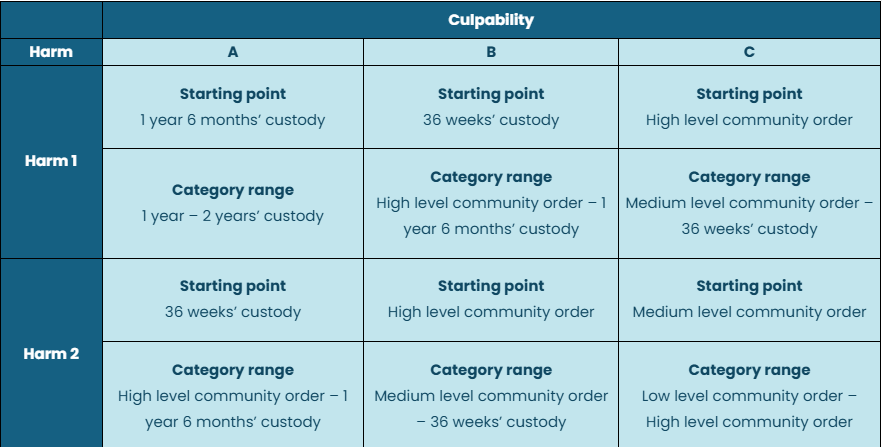
Dangerous driving is one of the most serious motoring offences and can be dealt with in either the Magistrates' Court or the Crown Court. If you plead guilty or are found guilty, the court will sentence you using Sentencing Council guidelines.
The sentence will depend on the facts of the case. The court will assess both harm and culpability. In relation to harm, it will consider whether injuries were caused to others and whether any damage was caused to vehicles or property. In relation to culpability, the court will examine the manner of driving and any aggravating features such as the prolonged use of a mobile phone, significantly excess speed, racing or the influence of alcohol or drugs.
Courts use sentencing categories based on seriousness (as set out in the table below) to decide the likely starting point for a community order or custody. Sentencing powers range from a low level community order up to a maximum of 2 years custody. The court must also impose a driving disqualification for at least 12 months with the requirement to undergo an extended re-test before you can drive again.
Causing Serious Injury by Dangerous Driving
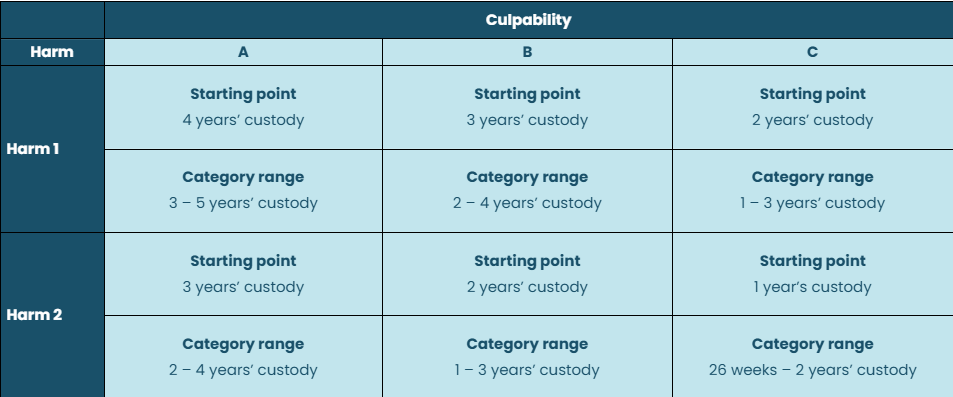
Where the allegation involves serious injury sentencing powers increase significantly and most cases are dealt with in the Crown Court. If you plead guilty or are found guilty, the court will again assess both harm and culpability when determining sentence.
In assessing culpability, the court will assess the same factors outlined above for the offence of dangerous driving. In assessing harm, the court will consider the nature and extent of the injuries. This includes whether the injuries sustained were life threatening, resulted in lifelong dependency on third party care, or caused a substantial and long term effect on the victims ability to carry out normal day to day activities. Medical evidence will often play a central role in determining the appropriate sentencing category.
Courts use sentencing categories based on seriousness (as set out in the table below) to decide the likely starting point for a custodial sentence. The sentencing powers range from 26 weeks custody to a maximum of 5 years custody. The court must also impose a driving disqualification for at least 2 years with the requirement to undergo an extended re-test before you can drive again.
Causing Death by Dangerous Driving
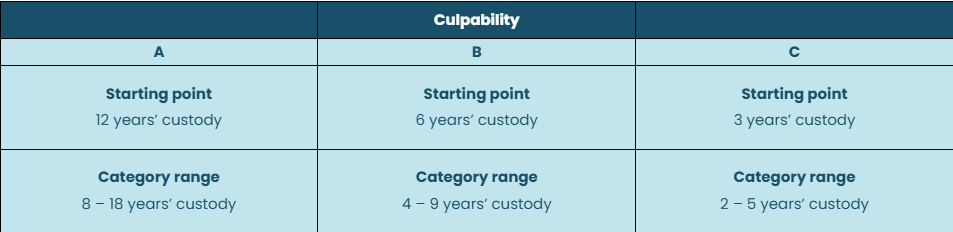
Where the allegation involves death, sentencing powers increase further and all cases are dealt with in the Crown Court. The Court will again consider culpability and the surrounding circumstances of the driving, but the level of harm will inevitably be of the highest seriousness given that a life has been lost.
Courts use sentencing categories based on seriousness (as set out in the table below) to decide the likely starting point for a custodial sentence. The sentencing powers range from 2 years custody to a maximum of life imprisonment. The court must also impose a driving disqualification of at least 5 years with the requirement to undergo an extended re-test before you can drive again.
If you’re worried about a driving ban or custody, you should obtain specialist advice as early as possible. We will give you a clear view of the likely sentence based on your circumstances and advise you on the best way to protect your position.
Accused Of Dangerous Driving?
Whether you have been charged or released under investigation, we’ll guide you through the process and fight for the best possible outcome.
What to Do if You’ve Been Charged
If you’ve been arrested or received a postal charge for dangerous driving:
Do not ignore it —
you may be required to attend court.
Contact us immediately —
early legal advice can significantly influence the outcome.
Have your paperwork ready — we’ll review your charge sheet and any other paperwork you have received.
Our solicitors will explain the process and review your case in detail. We will provide clear, practical advice on your options.
Exclusive Focus on Motoring Law
Fixed Fees for Every Case Type
Free Initial Consultation with a Solicitor
Nationwide Representation