
Call For A Free Consultation
✅
Immediate Legal Advice
✅ Failure To Provide Specialists
✅ Free Initial Case Review
Charged with failing to provide a specimen? You could face a driving ban. If you’ve been arrested or given a court date, speak to a solicitor today.
Failure To Provide A Specimen Defence Solicitors for England & Wales
Quick Callback
We will get back to you as soon as possible.
Please try again later.
Specialist Motoring Lawyers.
If you’ve been accused of failing to provide a specimen for analysis, you’re facing one of the most serious motoring offences under the Road Traffic Act 1988. The courts treat this offence in the same way as drink or drug driving — with penalties including a mandatory driving ban and, in more serious cases, imprisonment.
At Verida Legal, we specialise exclusively in motoring law. Our solicitors have defended hundreds of motorists accused of failing to provide a specimen, whether for breath, blood or urine testing.
Failing to provide a specimen for analysis is treated by the courts in a similar way to drink driving or drug driving and the penalties can be just as severe. It doesn’t matter whether the request was for
breath, blood, or urine
and it doesn’t matter what originally led to you being stopped. In many cases, it also doesn’t matter whether you had actually consumed alcohol or taken drugs. The court will focus on
why you did not comply
with a lawful requirement.
Motorists can face this allegation for different reasons. If you’re found guilty (or you plead guilty), the starting point can be
a driving ban and a fine
and in more serious cases you may also be at risk of
a community order or custody.
If you’ve received paperwork or you’re due in court, don’t guess your way through it. Early advice can make a real difference. Whether you’re defending the allegation or looking to reduce the impact of the sentence.
Call us on
01942 364493
or use our contact form and we’ll call you back.

Charged with Failing to Provide a Specimen?
Contact Us
Call us on 01942 364493 or enter your details below:
Request A Callback
We will get back to you as soon as possible.
Please try again later.

What The Law Says
Under section 7(6) of the Road Traffic Act 1988, it is an offence to:
To fail, without reasonable excuse, to provide a specimen of breath, blood or urine when lawfully required by the police.
This offence can be committed even if you were not driving a motor vehicle.
What the Prosecution Must Prove
To secure a conviction, the prosecution must show that:
- The officer made a lawful request for a specimen.
- The correct procedure was followed and the statutory warning was given to you.
- You failed to provide a specimen.
- You did not have a reasonable excuse for failing to comply.
Our solicitors carefully review the evidence to identify any potential defences that may be available to you.
Failure vs Refusal
There is a clear legal distinction between failure and refusal. A refusal occurs when you deliberately choose not to provide a sample after being warned. A failure occurs when you try but cannot comply.
Understanding this distinction is critical, as many police officers wrongly record a “refusal” when in fact the driver was unable, not unwilling, to comply. Many people face harsher sentences for deliberately refusing to provide a specimen.

How We Defend Failure to Provide a Specimen Charges
Every case is different and small details can make a big difference.
That is why it is crucial we review the evidence thoroughly.
Our solicitors examine all aspects of the case and identify possible defences.
Depending on the circumstances, we may look at:
Reasonable Excuse
A key issue is often whether you had a reasonable excuse for not providing. This can include medical reasons or genuine inability.
Police Procedure
Police must follow strict steps and give the correct statutory warning. If they didn’t, it can weaken the case. We check the timeline & paperwork for errors.
Did You Have Capacity?
If you suffer with mental health conditions or learning difficulties and these conditions were heightened during the evidential procedure, this can amount to a reasonable excuse for failing to provide. Medical evidence and the surrounding circumstances are often crucial in establishing this defence, so early legal advice is important to assess whether it applies in your case.
Needle Phobia
Did you fail to provide a specimen of blood due to a needle phobia? If you have a genuine phobia of needles this may amount to reasonable excuse for failing to provide. Early legal advice can help determine whether this argument is likely to succeed in your case.
Driver vs Non-Driver
A common misunderstanding is that you can avoid conviction by arguing you were not driving. That is not correct. Failing to provide a specimen can still be committed whether you were driving or not.
However, the distinction still matters. If you were driving, the court must impose a disqualification. If you were not driving, the case is dealt with on an “in charge” basis, and the court may impose penalty points instead of a ban.
Where there was no realistic prospect of you driving the vehicle, this may amount to a special reason not to disqualify, following McCormick v Hitchens. In some cases, this can mean avoiding both a disqualification and penalty points.
See our
Special Reasons Arguments Page
for more information.
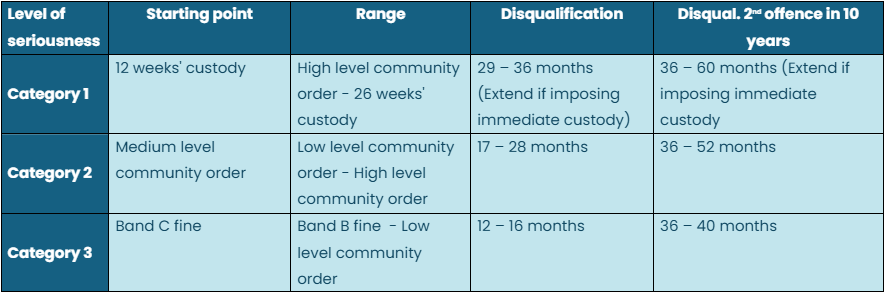
Sentencing Guidelines for Failing to Provide a Specimen
Failing to provide a specimen (breath, blood, or urine) is treated as a serious offence in England and Wales. If you plead guilty or are found guilty, the court will sentence you using Sentencing Council guidelines.
The outcome depends heavily on the facts — including whether this was seen as a deliberate refusal or whether there was evidence of a high level of impairment. Courts use sentencing categories based on seriousness to decide the likely starting point for a fine, a community order or custody and the length of any disqualification.
If you were “in charge” of a vehicle (not driving)
The court can still prosecute if you were “in charge” of a vehicle and failed to provide when lawfully required. The aggravating a mitigating factors remain the same.
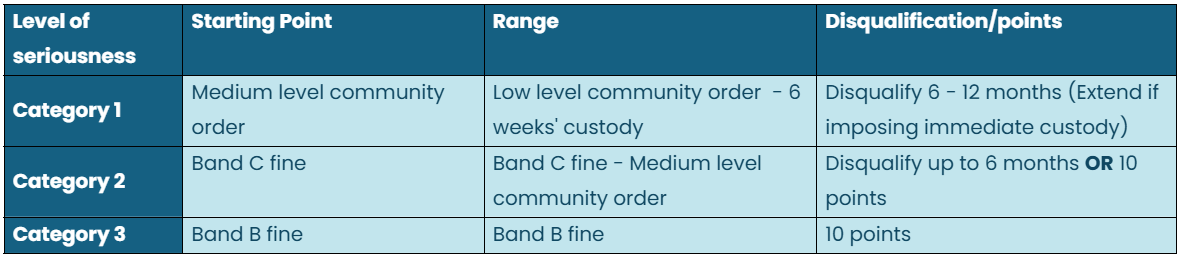
If you’re worried about disqualification or custody, we’ll explain the likely range based on your circumstances and what can be done to reduce the impact where possible.
Failed To Provide A Specimen?
Whether you have been charged or released under investigation, we’ll guide you through the process and fight for the best possible outcome.
What to Do if You’ve Been Charged
If you’ve been arrested or received a postal charge for failing to provide a specimen for analyis:
Do not ignore it —
you may be required to attend court.
Contact us immediately —
early legal advice can significantly influence the outcome.
Have your paperwork ready — we’ll review your charge sheet and any other paperwork you have received.
Our solicitors will explain the process and review your case in detail. We will provide clear, practical advice on your options.

Exclusive Focus on Motoring Law
Fixed Fees for Every Case Type
Free Initial Consultation with a Solicitor
Nationwide Representation