

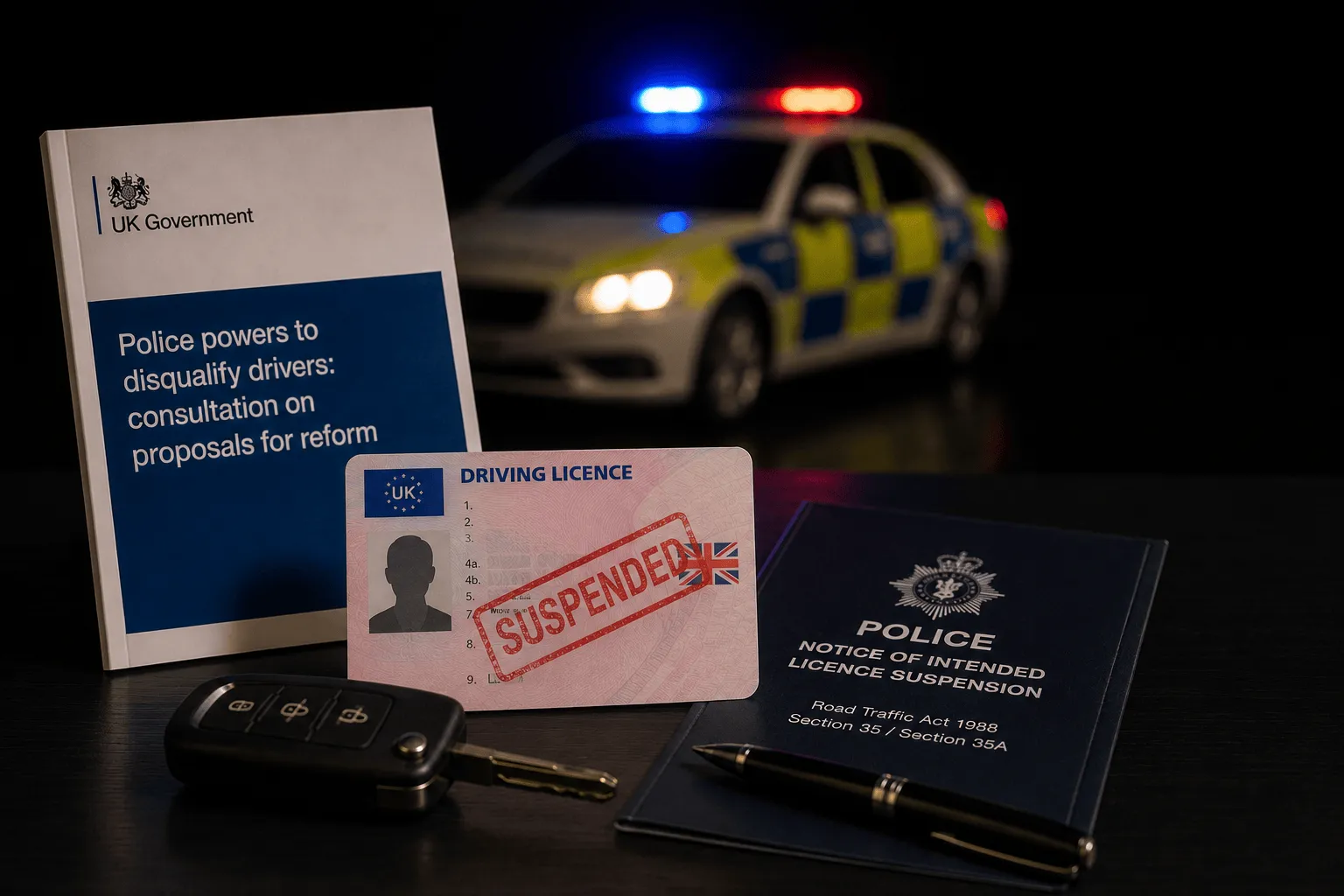
If you have been stopped by the police for an alleged motoring offence, one of the first questions you may ask is:
“Can the police suspend my driving licence immediately?”
The answer, in most cases, is no.
Despite some recent headlines, police officers in England and Wales do not currently have a general power to suspend your driving licence at the roadside simply because you have been arrested or accused of a motoring offence. In almost all criminal motoring cases, it is the court that decides whether a driver should be disqualified.
However, that position could change.
The Government has recently announced proposals as part of its Road Safety Strategy that include giving the police stronger powers in relation to suspected drink and drug drivers. While no legislation has yet been passed, the proposals have generated significant discussion and could represent one of the biggest changes to motoring law in recent years.
What Is the Current Law?
At present, the vast majority of driving disqualifications are imposed by the courts, not the police.
For example, if you are arrested for:
- drink driving;
- drug driving;
- dangerous driving;
- careless driving;
- failing to provide a specimen for analysis; or
- causing serious injury by dangerous driving,
your driving licence is not automatically suspended simply because you have been arrested or charged.
Instead, the usual process is:
- You are investigated by the police.
- A charging decision is made.
- Your case proceeds through the criminal courts.
- If you are convicted, the court decides whether to impose a disqualification and for how long.
This reflects an important principle of the criminal justice system: a person is presumed innocent unless and until they are proven guilty.
Are There Any Existing Exceptions?
There are some situations where a driver may be prevented from continuing to drive immediately, but these are different from suspending a driving licence.
For example:
- the police may seize a vehicle where specific statutory powers apply;
- a vehicle may be prohibited from being driven if it is in a dangerous condition;
- a driver who has been arrested will obviously be unable to continue driving at that time.
In some circumstances, our solicitors have seen cases where the police have released a driver on bail, with a condition not to drive. Our solicitors have regularly been able to argue this is excessive and have the condition removed. However, this is still a tactic some police forces will occasionally use.
None of these situations amount to the police permanently or temporarily disqualifying a driver from holding a licence.

Why Is the Government Considering Change?
The Government has recently published proposals aimed at improving road safety, with particular focus on drink and drug driving.
One proposal under consideration would allow police officers to impose an immediate administrative driving licence suspension on motorists who fail evidential drink or drug tests, rather than waiting until their first court appearance.
The stated aim is to improve road safety by preventing drivers who are suspected of serious offences from continuing to drive while awaiting court proceedings.
At the time of writing, these proposals remain exactly that—proposals. They have not become law, and drivers should be cautious about media reports suggesting that police already have these powers.
Why Is This Proposal Controversial?
The proposals have prompted debate because they involve balancing two important public interests.
On one hand, there is a strong desire to improve road safety by preventing those who may pose a risk from continuing to drive.
On the other hand, any system that removes a person’s driving licence before a court has considered the evidence raises important questions about fairness and due process.
Our justice system has a key principle: innocent until proven guilty. Drink and drug driving offences carry a disqualification as a major part of the sentence. If those who haven’t been convicted yet are disqualified, they are effectively being punished before their guilt has been proven.
If an immediate suspension were introduced, some motorists could potentially lose their ability to drive for several months before their case is heard.

Could Court Backlogs Make the Problem Worse?
Potentially, yes.
Magistrates’ Courts across England and Wales continue to experience significant delays in many criminal cases. For example, in magistrates’ courts in and around Manchester (e.g. Wigan, Bolton, Stockport, Tameside), your first hearing is currently several months from being charged. If you plead not guilty, you are likely to be waiting a whole year before your trial date!
If an immediate suspension scheme were introduced without corresponding improvements to court capacity, some drivers could remain unable to drive for an extended period before a court determines whether they are actually guilty of the alleged offence.
That possibility is one reason why any proposed reforms are likely to be carefully scrutinised before becoming law.
Could You Challenge an Immediate Suspension?
As the proposals have not yet become law, the legal process for challenging any future suspension has not been finalised.
If legislation is introduced, it is likely that there will be safeguards and review procedures available to drivers. The exact details will depend on how Parliament chooses to implement any new powers.
Until legislation is enacted, however, any discussion of appeal rights remains speculative.
What Should You Do If You Are Arrested for Drink or Drug Driving?
If you have been arrested or charged with a drink driving or drug driving offence, it is important not to assume that a conviction is inevitable.
Every case should be carefully reviewed to consider issues such as:
- whether the police followed the correct legal procedure;
- whether evidential requirements were complied with;
- whether testing equipment was used correctly;
- whether there are any procedural or evidential weaknesses;
- whether any sample analysis is accurate.

Should You Seek Legal Advice?
If you have been arrested or charged with drink or drug driving, obtaining specialist legal advice at an early stage can make a significant difference.
Not every drink or drug driving case is straightforward. Procedural mistakes, evidential issues and legal defences may not always be obvious from the paperwork alone. An experienced drink driving solicitor can review the prosecution evidence, identify any weaknesses and advise you on the best course of action.
At Verida Legal, we specialise exclusively in defending motorists facing criminal driving offences throughout England and Wales. If you have been pulled over by the police, our solicitors can advise you on your rights and examine whether the correct legal procedures have been followed.
As always, our initial advice is free and given only by a specialist solicitor.
Get Expert Representation from Verida Legal
If you are charged with drinker drug driving:
👉 Do not go to court unprepared.
At Verida Legal, we provide:
- Clear advice from the outset
- Strategic case preparation
- Specialist court representation
Speak to our solicitors directly today for immediate support and free initial advice. Call 01942 364493 or click the link below to request a call back!
Speak To A Specialist Driving Solicitor
Frequently Asked Questions
Can the police take my licence away at the roadside?
In most criminal motoring cases, no. The police do not currently have a general power to suspend your driving licence simply because you have been arrested or accused of an offence.
Can I continue driving after being charged?
In many cases, yes. Unless your licence has been revoked under another legal process or a court has imposed a disqualification, you will often be able to continue driving until your case is concluded.
Are the new licence suspension powers already in force?
No. At the time of writing, the Government has announced proposals, but they have not yet been enacted into law.
Could the law change?
Potentially. If Parliament approves the proposed reforms, police powers in relation to drink and drug driving investigations may change in the future.
Further Reading
If you want more information about drink or drug driving offences, take a look at some of our other pages:
Our Dedicated Drink Driving Page: Click Here
Our Dedicated Drug Driving Page: Click Here
Blog: Can I Avoid A Drink Driving Ban In The UK?
Blog: Being Released Under Investigation: What You Need To Know